
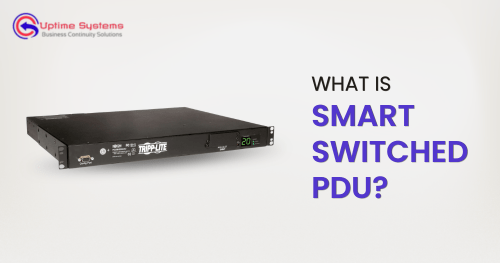
Power Distribution Units (PDUs) distribute power to several appliances within a rack or cabinet. They are placed between a primary power source and various IT equipment, such as servers, switches, and storage systems.
Customarily, these basic PDUs are focused solely on providing power and do not offer any monitoring or control capabilities. These devices function as sophisticated power strips for IT infrastructure.
With the increasing complexity of datacenter infrastructure, organization members now prefer intelligent models that allow monitoring of power consumption and system load.
What is a Smart PDU?
A Smart PDU is a basic PDU that also provides electrical load, voltage, and energy consumption data for devices installed in a rack. It also enables remote or on-site access, allowing IT staff to centrally monitor power consumption and locate overloaded circuits, distribute power load across circuits, and eliminate causes of outages. Power usage is recorded for planning production capacity, as the Smart PDU tracks power flowing through its circuits and consumption as graphs over time.
Types of Smart PDUs
Smart PDUs are generally categorized under the following two types based on coverage of others.
Monitored PDU
A monitored PDU helps monitor power by sensing voltage, current, and load at rack and outlet levels. It helps monitor power usage and prevent overload before it occurs. It concentrates on reporting and visibility and is not supposed to provide facilities for automatic control.
Switched PDU
The Switched PDU model has a monitoring facility, with outlet switching provided to enable remote switching via a powerful web interface. It is ordered to provide control on the outlets connected to the PDU. This control assists IT team members in switching on, switching off, rebooting, and managing equipment remotely. It is mainly used in remote sites such as large datacentres with one or more remote locations.
What is a Smart Switched PDU?
The comprehensive alternative to a regular Switched PDU is a Smart Switched PDU. Along with remote monitoring, they can also be switched on or off via network access. When a server becomes unresponsive or sluggish, the IT team could reboot it without a physical visit by simply cycling the power at that outlet.
Being able to reboot without visiting the data center saves time and money and improves service. It also enables them to maintain a remote record of power usage, which will help inform planning decisions for future data center upgrades.
Features of Smart Switched PDUs
- Full power load monitoring
- Remote switching of specific outlets
- Power consumption and tracking
- Flow balancing across several circuit levels.
- Remote reboot options
- Overload alarms
- Compatibility with network management integration
- Environmental factors
Differences Between Smart PDU and Switched PDU.
A smart PDU is considered an intelligent power distribution unit, whereas a Switched PDU is regarded as a smart PDU with additional remote-control features for power outputs.
The primary distinction is the ability to control. Smart PDUs help monitor power consumption, while Switched PDUs allow greater control of power flow from the unit.
Why you need a Smart Switched PDU?
Data centers require high power availability. An outage can mean not just time and money but also frustrated employees, moving customers, and lost productivity.
Beyond avoiding outages, data center administrators also need an overview of power consumption in order to plan upgrades and prevent overloaded circuits. Over time, the use of a smart switched PDU improves capacity upgrade planning and reduces operational risks.
FAQ:
- What Is the Difference between a Smart PDU and a Switched PDU?
A smart PDU provides monitoring and reporting of power usage. A switched PDU incorporates these features as well as remote control of individual outlets. - What does a Switched PDU do?
It allows you to control power outlets remotely—turning them on or off. Reboot equipment without physically being there. - What is a Smart PDU?
It is a smarter power distribution unit that offers online monitoring, reporting, and remote connection to power sources.